Translate

Saturday, November 15, 2014

Gender Remixed

Intro - Using the Remixer
Using the Gendered Lego Advertising Remixer, I mashed up some "girl" and "boy" Lego commercials; the remixer used the video from one set marketed to girls along with the audio from another set marketed to boys - or vice versa.  This technique underlined the different marketing techniques used for girls vs those used for boys.  See the link below if you want to see for yourself:
http://www.genderremixer.com/lego/#

The results were very interesting.  Honestly, I never really noticed the differences before using this remixer.  The boy commercials, in general, were geared toward things traditionally masculine: adventures and violence, using adventurous music with dark or monochromatic colors to enhance this idea.  The girl commercials, in general, were geared towards things traditionally girly: tinkly music, houses, cafe's, baking, hearts, animals.  All of these ideas were promoted by the colors of the girl Lego sets - pinks, purples, and any other pastel colors that look nice with them.  Something very interesting I noticed was the social aspect of the marketing.  Girls were always pictured together in the Lego Friends videos - from the beginning, all the way to the end.  In the boy Lego commercials, the boys were never actually shown playing.  The only "togetherness" you saw was from the Lego characters themselves - never in real life.  This certainly says something about how society views platonic relationships between males vs. those between females.

Gender Roles Influenced by Media
Now, I see nothing wrong with making "boy" and "girl" Legos, or other toys, for that matter.  It's the classification that creates the problem.  There are some who appreciate this difference.  I personally played with both types when I was younger.  For a long time they didn't have the ones made specifically for girls and I was perfectly content playing with the ones available - the Lego characters included girl figures, so I had everything I needed.  Then they came out with a set that I absolutely had to have - it was a "girl" set featuring a stable.  I'm not sure if it was truly the girl features that attracted me - I just liked the idea of having a stable.  I would have wanted the set regardless of which colors were presented in it.  But I do remember liking  the contrast of the "girly" Legos compared to the boring colors of the "boy" Legos.  I think it was more about having something different.

Something to note here is the fact that I was probably less affected than most when it came to marketing techniques and influence from the media because we really weren't allowed to watch TV when we were younger (that's a whole different story - I'll tell you about it sometime).  We played with both "boy" and "girl" toys without bias - we had barbies mixed right in with Hulk Hogan and the like.

This isn't the case with many kids though.  They are directed from a very young age by the images the media portray to them - and these images are further reinforced by their parents.  The message: Girls should be social butterflies who like to bake and do things in the home.  Boys shouldn't be so reliant on social relations.  Rather, they should focus on the "manly" things in life - like adventure and proving their manhood, etc.  As parents we need to actively engage our kids in conversations about these gender-stereotyped images presented to them in multiple ways.

Making Changes
We need to break down the barriers between "boy" and "girl" things in life.  Our kids should be able to do/play/act/think/feel anyway that is true to who they were born to be.  Some worry that if boys play with the feminine toys - or vice versa - that this act will influence their sexual orientation and/or gender identity.

Let me provide you with living proof right now that this notion is completely unfounded.  My son always played with my daughter's ponies and dolls, and my daughter always played with my son's toys (including cars, Nerf guns, "boy" Legos, dinosaurs, etc).  I never said a word about them being "girl" or "boy" toys.  For a while, my son's favorite color was pink.  I never said a word about it being a "girl" color.  I have taught my son to cook and clean, the same as I am teaching my daughter how to cook and clean.  And both of my children are perfectly "normal" - as viewed by the outside world.  My theory in life is you should do what makes you happy - not what makes everybody else happy.
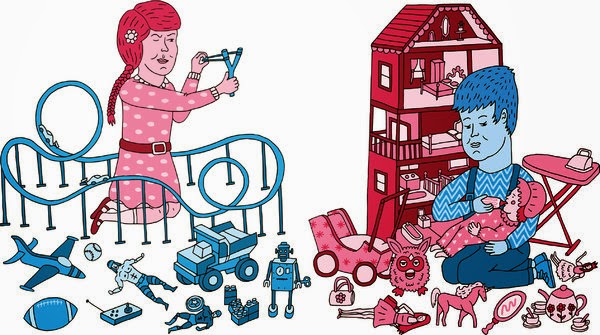
I am happy to see that this issue is becoming more prominent in society.  Barriers are being crossed in ways they never were before.  Disney is trying to break the mold and empower women.  ABC portrays the "Modern Family."  Granted, we still have a LONG way to go, but change is slowly but surely making its way into the media.  Though this slow change means parents need to take action - speak to your kids about gender roles/gender stereotypes.  Give them information that is on their level.  Here is a good article about this:
http://www.pbs.org/parents/childrenandmedia/article-stereotypes.html


Thursday, November 13, 2014

Engage Me!

All of our readings for this week have focused on the creation of online content and constructing meaning through that creation.  In my blogs, I have mixed this idea with the argument in favor of technology use in the classroom.
http://shawneeedu106.blogspot.com/2014/11/the-great-outdoors-vs-technology.html
http://shawneeedu106.blogspot.com/2014/11/intro-in-article-reading-images.html

I want to leave you with one last idea from Lawrence Lessig's Remix: Making Art and Commerce in the Hybrid Economy":

"Interest-based learning is the learning driven by found interests. When kids get to do work they feel passionate about, kids (and, for that matter, adults) learn more and learn more effectively."

I, for one, know this is true about my own learning experiences.  Ask me how much I remember from my classes here that didn't pertain to teaching.  If we know it is true about ourselves, then why wouldn't we apply it to our children/students?  And we wonder why we have so many children with attention problems in our classrooms.  Let's take advantage of the situation and show our children how to use this technology in a way that benefits them.  Let's engage our students!


Multimodality and Education

Intro
In the article Reading Images: Multimodality, Representation, and New Media, author Gunther Kress focuses on the changing forms of literacy and how we, as the designer of this literacy, need to focus on helping our audience make meaning of the text with the variety of media we use to represent our topic.  Gunther states that "the processes of making texts and reading texts are both processes of design" when technology is involved.  The texts are presented in a multimodal way, giving the reader the opportunity to make a decision for themselves about how they will make meaning from the information they are provided.

Given the rapidly changing modes of technology, the key question becomes "how to make my communication most effective in relation to this audience, here and now"?  Gunther gives us a variety of questions to consider in order to answer the previous:

  1. Which mode is best, most apt, for the content/meaning I wish to communicate?
  2. Which mode appeals to the audience whom I intend to address?
  3. Which mode most corresponds to my own interest at this point in shaping the message for communication?
  4. Which medium is preferred by my audience?  Or by me?
  5. How am I positioning myself if I choose this medium or this mode rather than those others?
Why Is This Important for Teachers?
As a teacher, these questions apply to learning in the classroom.  Technology is a great way to assess student learning.  It grabs the students attention by allowing them to interact with and summarize the learning material in a manner that is significant to them.  As we model making decisions to answer the above questions for our students through the assignments we give, our students become more capable of answering the questions for themselves.  This gives our students a strategy that will serve them not only in the classroom, but in whatever walk of life they choose.    

I had never heard of the term TPACK before doing some research for this blog, but it is this very idea of integrating learning with technology in order to make learning more meaningful for students.  Here is a brief overview:


Conclusion:
Many are afraid to integrate technology into the classrooms or even allow it into their homes, considering it an evil that should definitely be avoided.  Some feel it hinders children's social skills, while others feel it takes away from time that could be better spent in the great outdoors.  I am convinced it is all about balance, like everything else in life.  I am convinced that our students would benefit immeasurably by teachers including technology in the classroom - it is the "language" the kids speak and we should use it to our advantage.  

I have a feeling views on technology will change with time.  After all, it was one of the best known philosophers who said that writing will "produce forgetfulness in the minds of those who learn to use it" 

It was one of the greatest French writers who thought that the mass production of books would destroy the constructs of society; Hugo Victor's novel, the Hunchback of Notre-Dame is based on his quote "the book will kill the edifice."

Now, writing and books are the foundations of our education.  Those who think that technology will destroy the constructs of our society will see that it is becoming, and maybe already IS, the constructs of our globalized society today.


Monday, November 10, 2014

The Great Outdoors VS. Technology

This article was found on Facebook this morning with the comment: "My children won't have them"

http://theunboundedspirit.com/why-steve-jobs-didnt-let-his-kids-use-ipads/

I couldn't resist - I had to re-post it and comment on it with the following:

I think we are doing our kids a great disservice if we keep them from technology.  Whether we like it or not, the world revolves around technology...it is our future.  Its about setting appropriate boundaries and providing the proper guidance.  Technology is not all about mindless staring at a screen - that is a common stereotype.  And like other stereotypes, it needs to be dismantled. Technology is chock full of opportunities for our kids to be creative.  Just because they are building and imagining with pixels instead of blocks does not make the process less artistic.  In fact, it is probably more innovative because certain physical restrictions to the creative process have been removed.  We need to teach our kids to love and value both the great outdoors and the great world of technology - there needs to be a balance between the two.

Dismantling the stereotype:  
https://www.youtube.com/watch?v=0LhEZ_TJwuY
https://www.youtube.com/watch?v=jhc9Ywn0mXE

This dismantling of stereotypes is something we see in our articles for this week, as they discuss the creative side of New Media - see my blogs for additional dismantling:
http://shawneeedu106.blogspot.com/2014/11/intro-in-article-reading-images.html

Tuesday, November 4, 2014

Life Changing New Literacies

Intro
In chapter 15 of Best Practices in Teaching the New Literacies (Donald J. Leu, et al), the authors define new literacies, provide "principles that inform instruction in New Literacies," and help us understand how the New Literacies fit into the Common Core State Standards as a way of understanding the importance of teaching our students these New Literacies.

To begin, the authors define the difference between "New Literacies" and "new literacies" theories for the reader.  "New Literacies" is the general, all encompassing theory about technology in which the internet has become a defining, multifaceted technology that is essential for our students' success.  Therefore, it is necessary to teach our students how to become literate in using this technology.  This is where the "new literacies" come in.  These "new literacies" encompass all the little pieces that make up the skills and strategies necessary to survive and thrive in these rapidly changing technological innovations.  This lower case theory is used as a lens for viewing the requirements of the Common Core State Standards.

CCSS  
Because the Common Core State Standards never actually say the word "internet," teachers often overlook incorporating teaching literacy as a part of technology.  But if children are being taught to use computers/technology even at the tender age of 1, it would make sense that we should begin teaching them about new literacies at this time as well.

The authors cite various resources that accomplish this:
Starfall:  http://www.starfall.com/
ReadWriteThink.org:  http://www.readwritethink.org/

The authors go on to make a very interesting point:  teachers can give students who are struggling in reading a boost by teaching them this new technology first.  This positions these students, who were formerly seen as "dumb," as "experts" within the classroom - and maybe even outside of the classroom.

My Point of View
The idea of making the "last student" the first, has the power to change a students life.  Many times, students who struggle with reading have low self-esteem.  Even though schools try not to make the variety of reading levels obvious in each classroom, the students are well aware of their differences.  Not only are they aware of their differences, but they are painfully aware when they are the ones with the low reading level.  There has been much research regarding the correlation between a student's self-esteem and his/her instructional reading level, and it has been shown that there is a positive correlation between the two.

Moreover, once kids get this idea in their heads that they are "dumb," it creates a kind of wall in their thinking and becomes very difficult for them to think around.  My son has had difficulties with reading since he was in preschool, and he has always been well aware of this fact.  The trouble was, I wasn't aware that he was so acutely aware of his difference until it was too late.  I knew my son had difficulties with reading, but I also knew he wasn't stupid - he just learns differently than other students.  It took me years to break down that "dumb" wall that had formed in his head.  It took me years to get him to believe that he truly was smart, regardless of his reading level.  Just now, in 7th grade, he is beginning to enjoy reading.

Conclusion
My son was lucky.  He always made friends very easily and is well adjusted.  But I have seen other kids who weren't so lucky.  I have seen kids who withdraw from those around because they feel so different.  I have seen kids who get pushed to the side because their struggle takes up too much time.  I have seen kids who get teased mercilessly for being "dumb."  This idea of giving these kids back the power using one of their own strengths could totally change the way they view themselves. Suddenly, the roles are reversed.  Suddenly, these "dumb" kids have a purpose.  Suddenly, these kids who were ignored or made fun of have an expertise that all the other kids need - they are now a hot commodity, and that role has the power teach them valuable life lessons.  Its like the "starfish" story:

https://www.youtube.com/watch?v=uytlJ8urv4I    


Saturday, October 25, 2014

Experiences in Technology

My Experiences
The assignments for module 3 have really opened up a world of possibilities for me.  At first, I felt extremely overwhelmed as I read through the assignments we would have to complete this module.  But I took a deep breath and began, taking on the assignments one by one.  They really were a lot easier than they seemed like they were going to be, and I am actually enjoying the creating part, playing with the html on each page and finding new links, pics, and info to plug in.  It truly appeals to my artistic side – a side of me that often gets pushed to the back burner as I plow through my school work.  Making an annotation remix of the “identifying strategies” videos was way more fun than writing a paper about them.  And analyzing actual hoax websites was a great hands-on activity that could definitely be used in the school environment (and even with my own kids) to spark conversations about what makes a source credible vs. what makes a source not credible.  

See my blog on judging credibility for more info:  
http://shawneeedu106.blogspot.com/2014/10/how-do-we-judge-credibility.html


Extending My Experiences to the Classroom
Having students hack a website's credibility would be a great way to show students how easy it is to create your own hoax website – it would be an authentic learning experience that the students could connect with.  Sometimes students get the Charlie brown syndrome – when adults talk, all they hear is https://www.youtube.com/watch?v=ss2hULhXf04.  Sometimes you just can’t tell kids how it is – you have to let them see for themselves – and these exercises are a great way to do that.  

Sunday, October 19, 2014

How Do We Judge Credibility?

Think about how the author came across as credible.  How did the creators come off as experts?  What design decisions make the website seem credible?  

Site C - Computer Tan:

- Home page has a video with a tanned model, as if she has used the
  product successfully herself
- Video and links include scientific-like explanations and terms
- Site offers a free trial
- They also have a mobile app
- The have an FAQ link
     * Uses scientific-like explanations
     * Has specific questions that create connections with the potential
        customers
          - i.e. customers are only allowed 1 session per day to protect
            them from overexposure
          - sends the message "we care about you and your well being"

Site D - Ova Prima:

- About section lends credibility
     * Since 1887
     * partners in field of education
          - "Prestigious teacher's workshops"
- Describes their partnerships - all "experts"
     * In the field of education
     * In the scientific community
          - paleontology
          - oogenetics
          - archaeology
          - ovaprimatology
- The fact that they "fund education and research"
- Evidence of their research with pictures and professional looking articles
- New links with pictures, name drops (Dr. Phillips) and
  scientific terms (ova intra ova)
     * International level
     * National level
     * Personal level
          - Charity
          - Marriage of employees

Site E - GMail Tap:
- Has Google logo
- They give the people in the video official titles, like they are an official 
   part of the Google company
- In one of the videos, they connect the app to the movie I am
     * An "enlightened" kind of movie, so this app must be "enlightened" 
        as well
- They link an employee to a historically famous person
- Inspirational music playing with their inspirational message
- Appears to be connected to the actual Google site - when you click 
  the links it takes you to authentic Google links

How should I judge the credibility of authors online? 

After viewing the above hoax websites, it seems to me that it is quite easy to appear credible.  Judging credibility should not happen at the surface level (don't judge a book by its cover).  One must delve deeper in order to judge whether or not a source can be trusted.  Pictures, names, titles, logos, expert language, or the appearance of a "true website" do not add up to making a source trustworthy.  Who are the people in the picture?  Who is the Doctor, or the experts mentioned on the site - what have they accomplished?  If a site shows an official logo such as the Google GMail one, can you go directly to that source and find the product they are talking about? If a site claims to have a long history, supposedly proving expertise in a subject, can you find other info about this company to back up the claims?  Do the sources listed within the site actually exist?  Are they credible?  


Conclusion
It seems like every aspect of a site should be questioned in order to determine its credibility.  Some sites are obviously hoaxes.  Others are more difficult to judge, Don't take all the info a site gives you at face value - look into it and see if it checks out.